Jho Institute for Minimally Invasive Neurosurgery Department of Neuroendoscopy

Home | About Dr. Jho | Overview | Table of contents | Patient Registration Form | Directions, Contact & Hotel Information

Spine Diseases
 Cervical disc herniation
 Brain Diseases
Vertigo, Tinnitus, Cranial Nerve: Dr. Jho's Microvascular Decompression Cranial Nerve Surgery
Dr. Jho's Microvascular Decompression of VIII Cranial Nerve
Professor & Chair, Department of Neuroendoscopy
Jho Institute for Minimally Invasive Neurosurgery
Dr. Jho developed minimally invasive endoscopic microvascular decompression surgery for various neurovascular compression syndromes. Microvascular decompression is a surgical treatment for cranial nerve disorders such as trigeminal neuralgia, hemifacial spasm, vertigo, tinnitus, glossopharyngeal neuralgia, and spasmodic torticollis. Microvascular decompression (which consists of placement of small synthetic sponges between the compressing blood vessels and the affected cranial nerves) carries a good chance of relieving the symptoms associated with these disorders.
When blood vessels cross and compress cranial nerves, various characteristic symptoms develop depending upon which cranial nerves are compressed. Trigeminal neuralgia develops by blood vessel compression of the trigeminal nerve, hemifacial spasm by compression of the facial nerve, intractable positional vertigo by compression of the vestibular nerve, tinnitus by compression of the cochlear nerve, glossopharyngeal neuralgia by compression on the glossopharyngeal nerve, and spasmodic torticollis by pressure on the spinal accessory nerve and upper cervical nerves. Cranial nerve surgery is done through a small skull opening behind the ear and is referred to as retromastoid craniectomy. Skin incisions are usually only two inches in length.
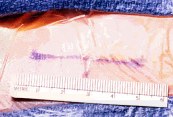
Figure 1. For microvascular decompression, a 4-cm skin incision is made behind the patient's ear.
A:  B:
B: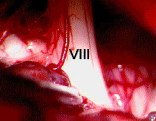
B:Figure 2. Intraoperative photograph reveals a large vein (V in white) cross-compressing the 8th cranial nerve (VIII) in a patient with vertigo (A). The compressing vein is eliminated for the decompression of the 8th nerve (VIII) (B).
A: B:
B: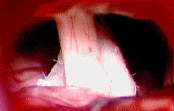 C:
C:
B: C:Figure 3. Intraoperative photograph shows an artery compressing the 8th nerve, causing intractable tinnitus (the artery is located between the 7th and 8th cranial nerves) (A). The 8th nerve is decompressed by the placement of a Teflon sponge (B). This patient's successful operation was reported in this foreign newspaper (C).
 For referral information or appointment for consultation contact:
 Practice Manager: Robin A. Coret
 e-mail : Drjho@ahn.org
 Tel : (412) 359-6110
Fax : (412) 359-8339
Address : JHO Institute for Minimally Invasive Neurosurgery
Department of Neuroendoscopy
Sixth Floor, South Tower
Allegheny General Hospital
320 East North Avenue
Pittsburgh, PA 15212-4772


 Dr. Jho via e-mail Drjho@ahn.org
Copyright 2002-2032